Cut it on the fire
A slab of pork belly is laid across a grill set into the middle of the table. It is not portioned. It is a long, uncut piece, and it sits there sizzling for several minutes while nothing happens to it.
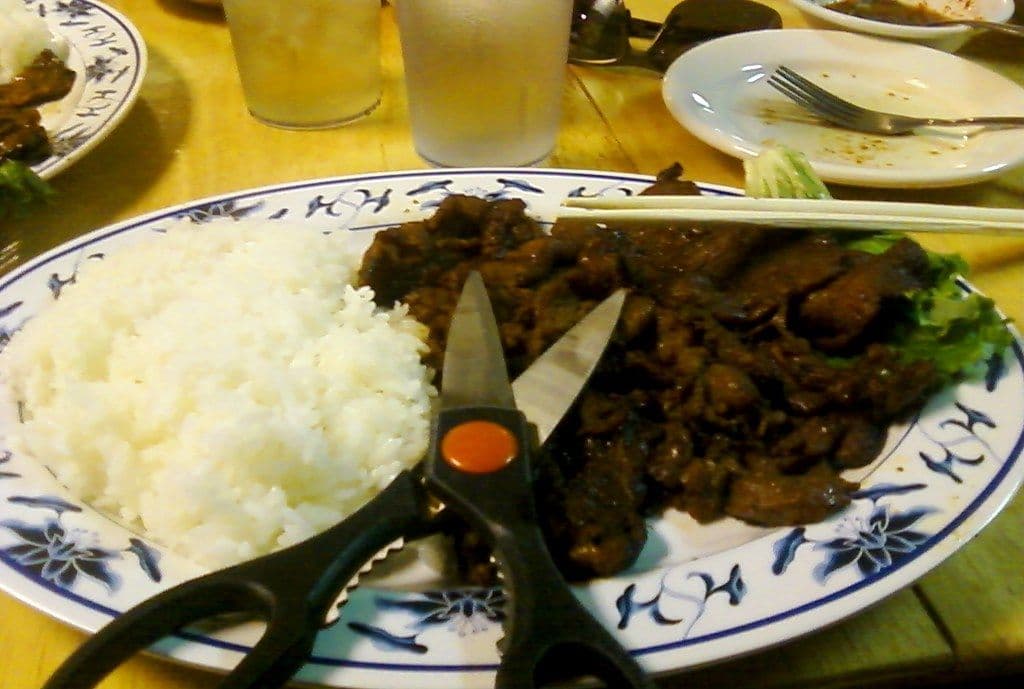
Then someone — a member of staff, or the person at the table who has taken charge — picks up a pair of tongs in one hand and a pair of kitchen scissors in the other, and cuts the meat into squares directly over the flame. Not on a board. Not on a plate. On the grill, with shears, while it cooks. The pieces are pushed to one side to finish, and the tongs and the scissors go back on the rest at the edge of the table.
The scissors do not go away. They will be used again on the kimchi, and if there are noodles later, on those too.
The instinct that never fires
Most visitors arrive with a deeply installed sequence for eating meat: the food arrives portioned, or you portion it yourself, on your own plate, with a knife you hold in your dominant hand and a fork that pins it down. That sequence is so automatic that people do not experience it as a technique.
Here it simply never gets used. There is no knife at your place setting, because Korean tables do not set knives — the utensils are a spoon and a pair of metal chopsticks, and they came out of the drawer under the table. Cutting is not something that happens on your plate at all. It happens once, communally, at the cooking surface, before anyone has taken anything.
Visitors describe reaching for a knife that is not there, and then noticing that the meal has already solved the problem the knife was for. What follows is a small reorganisation of how eating works: you take a finished piece with chopsticks, put it on a leaf of lettuce with garlic and paste, wrap it, and eat it in one go. No cutting occurs on your side of the table at any point.
The first time visitors are handed the scissors themselves, there is usually a moment of hesitation that has nothing to do with difficulty. It is the feeling of being asked to use the wrong tool.
Why the scissors make sense
Grilling whole, then dividing, is better cooking. A large piece on a hot surface loses less moisture than several small ones, and it can be turned and managed as a unit. Cutting it after it has seared, when the outside is set and the fat has rendered, produces a better result than putting pre-cut cubes on the grill. The tool has to work on cooked meat over heat, which is a specific job.
A knife cannot do that job. A knife needs a board and a downward stroke, and there is no board, and the surface is a grill you cannot press against. Shears cut in mid-air, at a distance from the heat, with one hand, while the other holds tongs. They also work equally well from any angle around a round table, which matters when several people are reaching.
The table was never set for cutting. The Korean place setting is a spoon and chopsticks, and has been for a very long time. In a table culture with no knife tradition, the arrival of a task that requires cutting does not summon a table knife — there isn't one to summon. It summons a tool from the kitchen, and the kitchen's cutting tool for awkward, floppy, hot things is a pair of shears.
The food keeps needing it. A whole cabbage kimchi is served as long leaves that want dividing at the table. Cold noodles are served in a coil so long they are genuinely difficult to eat, and are routinely cut in the bowl. Seaweed, spring onion, blood sausage, whole grilled fish — the cuisine serves a lot of things long and whole. Shears are simply the general-purpose answer.
What this is not
It is not improvisation, and it is not a sign of casualness at the table. These are proper utensils — heavy, purpose-made food shears, cleaned and stored with the rest of the equipment, often sold as restaurant supply and owned by every household kitchen. Reading them as a make-do solution imports a hierarchy of tools that is not present here.
Nor is it a hygiene shortcut. The scissors used on your grill are the restaurant's scissors for that table, and the discomfort visitors sometimes feel comes from a mental association with scissors in general — the drawer at home holding one pair that has cut paper, string, packaging and hair — not from anything that is actually happening.
It is also not universal across the meal or across the cuisine. A great deal of Korean food arrives in pieces that need no cutting, and the scissors belong to particular dishes rather than to every table. Fine-dining restaurants may portion in the kitchen. And in some situations it is the staff who cut, in others the youngest person at the table, and in others whoever is nearest — a small social question that visitors are usually spared.
Why it lands as a surprise
Of everything on this list, this is the item with the least practical consequence and one of the most reliable reactions, which tells you the surprise is not about function.
It is a category error, and a specific one. In most countries scissors live in the utility drawer, alongside tape and batteries, filed under office, craft and household repair. The tool carries a domain with it. Watching it applied to dinner is not surprising because it works badly — it works better than the alternative — but because it crosses a line between categories that the visitor did not know they were maintaining.
The reaction that follows is characteristic: a laugh, a photograph, and then, almost immediately, the recognition that it is obviously the right tool and that the visitor's own kitchen has been solving this problem worse for their entire life. Very few culture shocks resolve into agreement that quickly.
And it lands hardest on people whose table manners were most formalised. Someone raised where the knife-and-fork sequence carried real social weight feels a small transgression at the sight of it. Someone raised eating with chopsticks, or with hands, or at tables where food is torn and shared, watches the same grill and sees nothing worth mentioning. The scissors are just scissors. The distance they travel depends entirely on where the person watching set their zero.