The board says four minutes
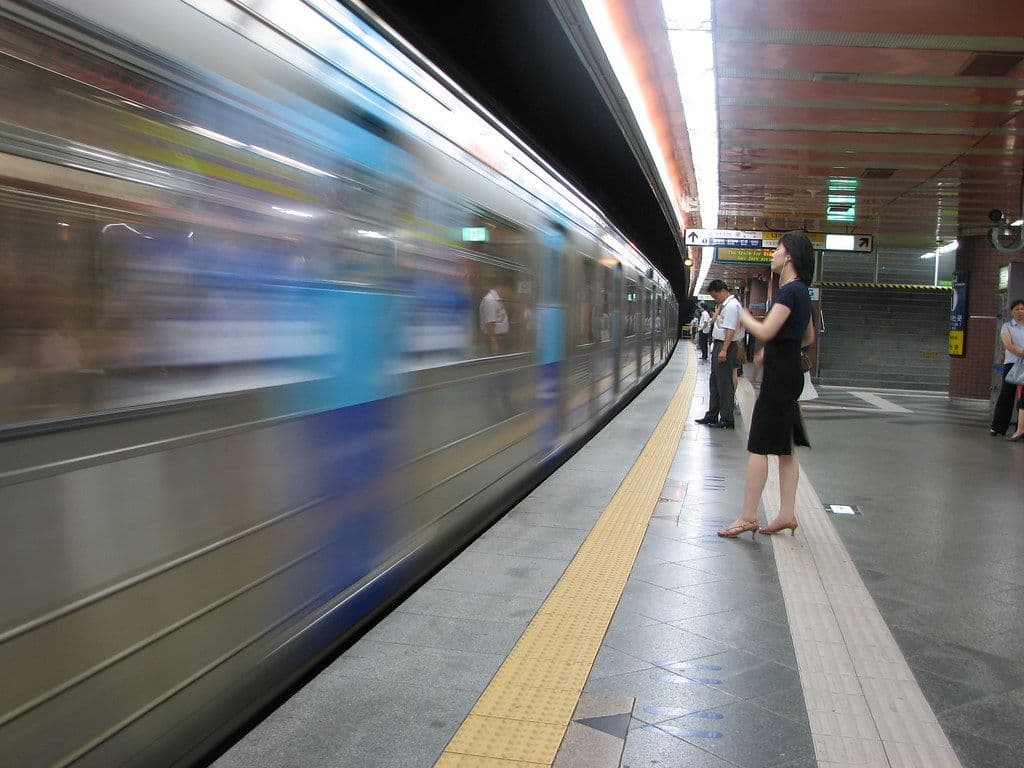
Stand on a subway platform in Seoul and look up. A screen tells you the next train is four minutes away, and which station it has just left, and how full each carriage is. Behind you the platform is sealed off from the track by a wall of glass doors that will open exactly where the train's doors stop. The floor is dry. The air is conditioned. When the train arrives, it arrives in four minutes.
Then you go up to street level, tap the same card on a bus, and no second fare is charged, because the system has decided the bus and the train were one journey rather than two purchases.
What stops happening
Visitors rarely describe this as impressive at first. They describe it as an absence of friction they only notice later, usually on the day they realise they have stopped doing something.
The first thing to go is the buffer. Most people carry an unconscious padding around any trip that depends on transport — leave twenty minutes early, because the connection might not hold. After a few days here that padding starts to feel like wasted time, and people begin planning to the minute in a way they would never risk at home. The second thing to go is the check. You stop looking up whether the line is running, because the question has stopped being interesting.
The third is subtler. In a system where transfers are free and the fare follows the distance rather than the number of vehicles, you stop optimising. There is no reason to walk fifteen minutes to avoid a second fare, no reason to choose the worse route because it is the cheaper one. The route you take becomes the route that is fastest, which is a small change to how a city feels underfoot.
And there is the cleanliness, which people notice as a kind of confusion. Floors get mopped during service hours. Seats are upholstered rather than moulded plastic, which is a decision you can only make if you expect them to stay clean.
Why it works
It was built late, and quickly. Most of the network is young by the standards of the world's big metro systems. Seoul did not inherit a nineteenth-century tunnel diameter or a century of incompatible signalling. When you build in a compressed window, you build to one standard, and retrofits like platform screen doors are cheaper across a fleet that is broadly uniform.
The fare system treats a trip as a trip. Multiple operators run the buses and the trains, and the fare structure sits above all of them, settling accounts between companies in the background so that the passenger never sees the seam. This is a policy choice rather than a technical achievement, and it is the part that is hardest to copy, because it requires operators to give up the right to charge you separately for their own vehicle.
Density makes frequency affordable. A four-minute headway is not generosity; it is what you run when the trains fill up anyway. Korean cities concentrate enormous numbers of people along the corridors the lines follow, which means high frequency is the cheap option rather than the expensive one. Frequency, in turn, is what makes punctuality legible — when the next train is always close, a delay is measured in minutes rather than in a ruined afternoon.
Maintenance is continuous rather than nocturnal. Cleaning, repair and inspection are staffed as ongoing work rather than as a night shift that catches up on the day's damage. This costs labour, and it is the reason the system looks the way it does at 4pm and not only at 6am.
These reinforce one another. Young infrastructure is cheaper to keep clean; frequency reduces crowding damage; integrated fares raise usage, which funds the frequency.
What this is not
It is not comfortable. Line 2 at 8.30am is a physical experience that no amount of punctuality redeems, and visitors who arrive with a story about Korean transport being pleasant tend to revise it after one weekday morning. Buses are driven briskly, and standing on one requires a hand on something.
It is not free, and it is not uniformly excellent. Fares are modest but real. The quality described here is a metropolitan phenomenon; a smaller city or a rural route is a different system with different frequencies, and the further you get from the capital region the more the experience resembles the ordinary one. The subway also stops for the night, and the gap between the last train and the first is a real constraint that locals plan around carefully.
Nor is any of this evidence of some special national aptitude. It is money, timing and policy, and Koreans will tell you about the strikes, the construction delays and the lines that were promised for years before they opened.
Why it lands as a surprise
There is nothing objectively astonishing about a train arriving when the sign says it will. The surprise is not in the fact but in the distance between the fact and what the visitor's body was expecting.
Transport is one of the deepest baselines people carry, because it is one of the few systems they interact with daily without choosing to. If you grew up somewhere where the timetable is an aspiration, you have built a whole apparatus around that — the padding, the backup route, the resigned scanning of a departures board. That apparatus is invisible to you until it has nothing to do. What visitors report is not admiration so much as the specific vertigo of a coping mechanism going idle.
This also explains why the reaction splits so sharply. Someone arriving from a city with a dense, punctual, well-funded network notices the screen doors and the transfer rule and little else, and finds the fuss slightly overblown. Someone arriving from a city where a commute is a daily negotiation experiences something closer to relief. Both are describing the same platform. They are measuring from different zeros.
And unlike most travel surprises, this one is cumulative rather than instant. It does not land on the first ride. It lands on the fifth day, when you leave the hotel eight minutes before you need to be somewhere and are not nervous about it.