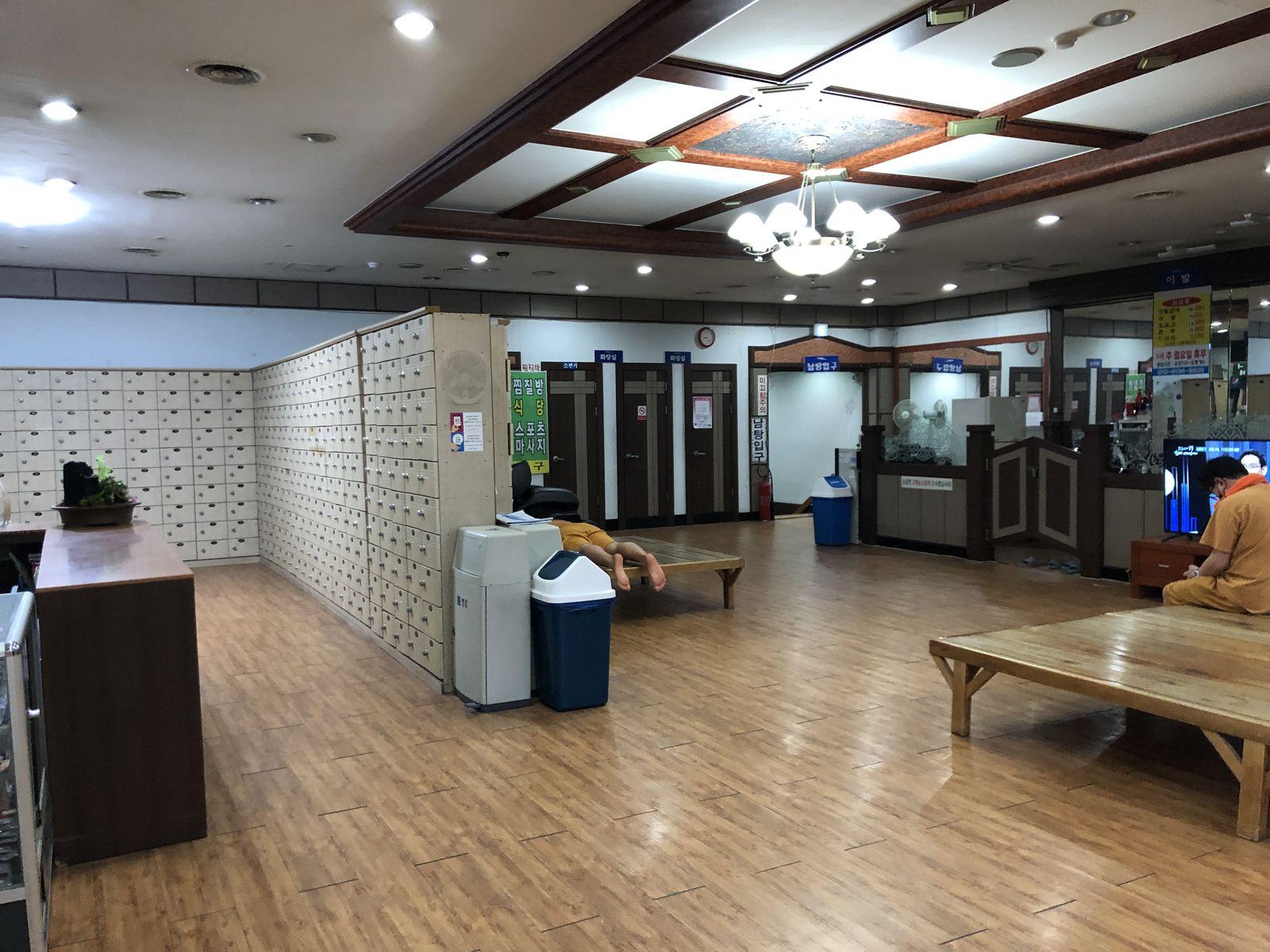
A room full of people asleep
It is three in the morning on the shared floor of a jjimjilbang. The lighting is low but not off. Perhaps forty people are lying on the heated floor in identical cotton shorts and T-shirts, most of them asleep, some with a small wooden block under their head instead of a pillow. A television is on with the sound down. In the corner, two people are eating boiled eggs. Somebody's child is running between the sleepers and nobody minds.
Downstairs there is a bathing floor, divided by gender, where the same people were an hour ago, naked, moving between pools of different temperatures. Upstairs there are dry saunas at temperatures that have to be experienced to be believed, and a cold room, and rows of massage chairs.
The whole thing runs all night, and a substantial number of the people here are not visiting. They are sleeping here because it is where they are sleeping tonight.
The sequence, and where people get lost
Almost every first-timer stumbles in the same places, and the stumbling has a shape worth describing, because it is most of the experience.
You take your shoes off immediately on entering and put them in a small locker, and you take that key to the counter. In exchange you are given a wristband, a numbered locker in the changing room, and a set of clothes — shorts and a shirt, usually in a colour that indicates gender. The wristband is the important object: it opens your locker and it functions as your account for the rest of the visit, so the noodles and the drinks and the boiled eggs are all charged to your wrist and settled when you leave.
Then comes the part that stops people. On the bathing floor you are naked. Not partially, not with a towel wrapped around you — the towel is small, and it is for drying and for sitting on. Swimwear is not worn. You wash thoroughly at a seated shower station before entering any pool, and this is the one rule about which there is no flexibility at all. The pools are shared water and everyone enters clean.
Afterwards you dress in the issued clothes and go up to the shared floor, where everything is mixed and everyone is covered. The saunas, the snack bar, the sleeping areas and the television room are all up here. First-timers often skip this floor entirely, having assumed the bathing was the whole thing, and miss the part that makes the place unusual.
Why the building works like this
Heat is expensive to start and cheap to keep. A sauna complex heats enormous quantities of stone, water and floor. Shutting for eight hours means paying to cool down and paying again to warm up. Once the building is hot, keeping it open overnight costs a night attendant and very little else, which is why round-the-clock operation is the default rather than an ambitious extra.
It descends from public bathing, not from wellness. Within living memory, many Korean homes had minimal bathing facilities, and the neighbourhood bathhouse was ordinary infrastructure. The jjimjilbang is what that institution became when it grew, added floors, and started selling snacks — which is why it feels like a public utility with amenities attached rather than a spa.
It is social and familial rather than solitary. People come in families and in groups. Children come. Older relatives come. The shared floor exists because the point was never only to get clean; it was to spend several hours somewhere with people you know.
It absorbs a city's overflow. The last train goes, the night is long, accommodation is expensive, and here is a warm floor with lockers and showers that costs less than a hotel. That function is not incidental. It is a large part of why the shared floor is full at 3am.
What this is not
It is not a spa in the Western sense. Many jjimjilbang are plainly utilitarian: tiled, brightly lit, a bit worn, smelling of hot cedar and detergent. The luxurious ones exist, but the ordinary one is a functional building doing a functional job, and a visitor arriving with resort expectations will be puzzled rather than pampered.
It is not sexual and it is not treated as risqué. The nudity is thoroughly desexualised and generationally normal, and staring is the single clearest way to behave badly.
It is not a comfortable night's sleep. The floor is hard, the lighting stays on, people come and go, and someone will snore. It is a place to sleep, not a good place to sleep, and people use it accordingly.
And the details vary widely between establishments — how long you may stay, whether the sleeping areas are separated by gender, whether the place caters to families or to workers. There is no single national version of this, and the honest description is of a type of building rather than of a standard one.
Why it lands as a surprise
Two quite different shocks live inside this item, and which one a visitor gets depends entirely on where they are from.
The first is the nudity. For visitors raised in bodily-private cultures, the bathing floor is a real threshold — not because anything is happening, but because the assumption that the naked body is private in public space turns out to be local rather than universal. Most people report crossing it within about ten minutes and then wondering what the fuss was about, which is itself informative about how thin the assumption was.
The second is the sleeping, and this one lands harder on people who were untroubled by the first. There is a boundary in most societies between the public world and the domestic act of going to sleep, and a room where strangers sleep beside each other, uncontroversially, with children running about, is a boundary being ignored rather than crossed.
Neither shock is available to everyone. Visitors from cultures with their own bathhouse traditions find the bathing floor familiar and the shared floor novel. Visitors from communal-sleeping cultures find the reverse. The building does not change. What changes is which of a visitor's unexamined lines it happens to run across.